How to make flashcards that actually stick — for any topic (step-by-step)
By Thomas Løvås Lokøy
Founder & builder of BrainLoop (NorwegianSpark SA). I build the study tools I wanted when I was cramming the wrong way.
How to make flashcards that actually stick — for any topic (step-by-step)
Last updated: June 2026 · By Thomas Løvås Lokøy, founder & builder of BrainLoop. This piece was AI-assisted in drafting and fact-checked against the sources listed at the end.
Most people make flashcards the same way they highlight a textbook: it feels productive, but very little sticks. The good news is that flashcards done properly aren't just "fine" — they sit on top of the two study techniques researchers rate as the most effective of all. This is how to make cards for any topic and drill them so the answers are still there a week later.
Why flashcards work (the part most guides skip)
Flashcards are really a delivery system for one thing: active recall — forcing your brain to retrieve an answer instead of re-reading it. Decades of memory research show retrieval beats passive review. In controlled studies, learners who tested themselves on material retained substantially more on delayed tests than those who simply restudied the same content.1
The second ingredient is spacing — reviewing a card again after a gap rather than cramming it ten times in one sitting. When researchers ranked ten common study techniques, practice testing and distributed practice (spacing) came out on top as the only two rated high utility, while the perennial favourites — highlighting and rereading — were rated low utility.2 Flashcards, used right, are how you do both at once.
Step 1 — Break the topic into atomic facts
A good card holds one idea. If your card has three facts on the back, you'll know one, fumble the others, and never be sure which. Take your topic and split it into the smallest standalone questions you can:
- ❌ "Explain the French Revolution" (a whole essay)
- ✅ "What year did the French Revolution begin?" → 1789
- ✅ "What event is seen as its starting spark?" → The storming of the Bastille
This works for any subject — vocabulary, anatomy, capital cities, code syntax, sales objections. One question, one answer.
Step 2 — Write the question first, in your own words
Phrase the front as a real question you'd be asked, not a heading. "Closures?" is lazy; "What is a closure in JavaScript?" forces a genuine retrieval. Putting it in your own words also catches the illusion of knowing — if you can't phrase the question, you don't understand it yet.
Step 3 — Make the answer short and checkable
The back should be a sentence or two you can clearly say is right or wrong. If you can't grade yourself in two seconds, the card is too big — split it. Add a tiny cue or example if it helps the idea land, but resist turning the back into a paragraph.
Step 4 — Drill with honest active recall
Here's where most people cheat: they read the question, glance at the answer, think "yeah, I knew that," and move on. You didn't know it — you recognised it. The rule is simple: say or think the full answer out loud before you flip. Only then reveal it, and grade yourself honestly.
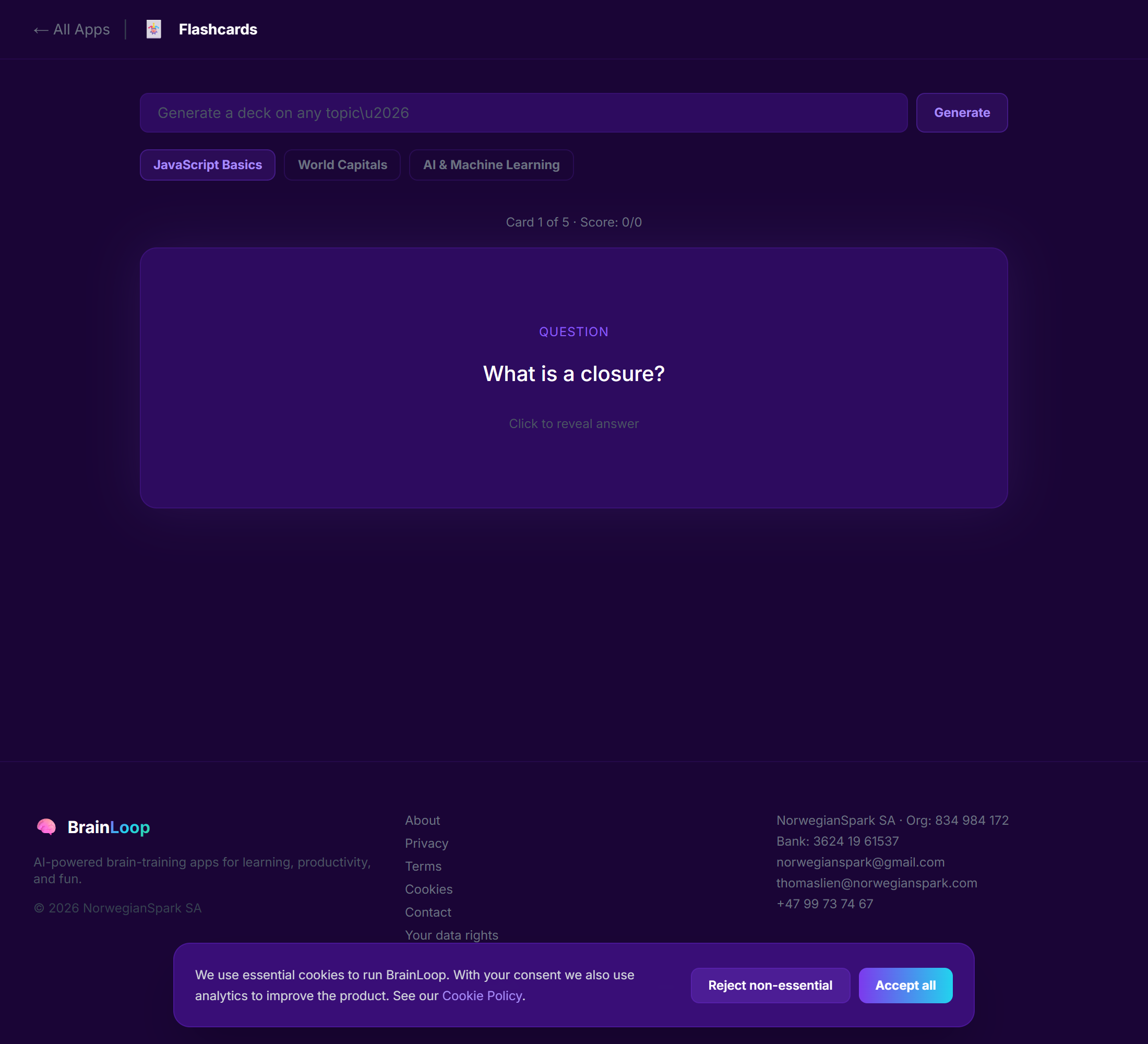
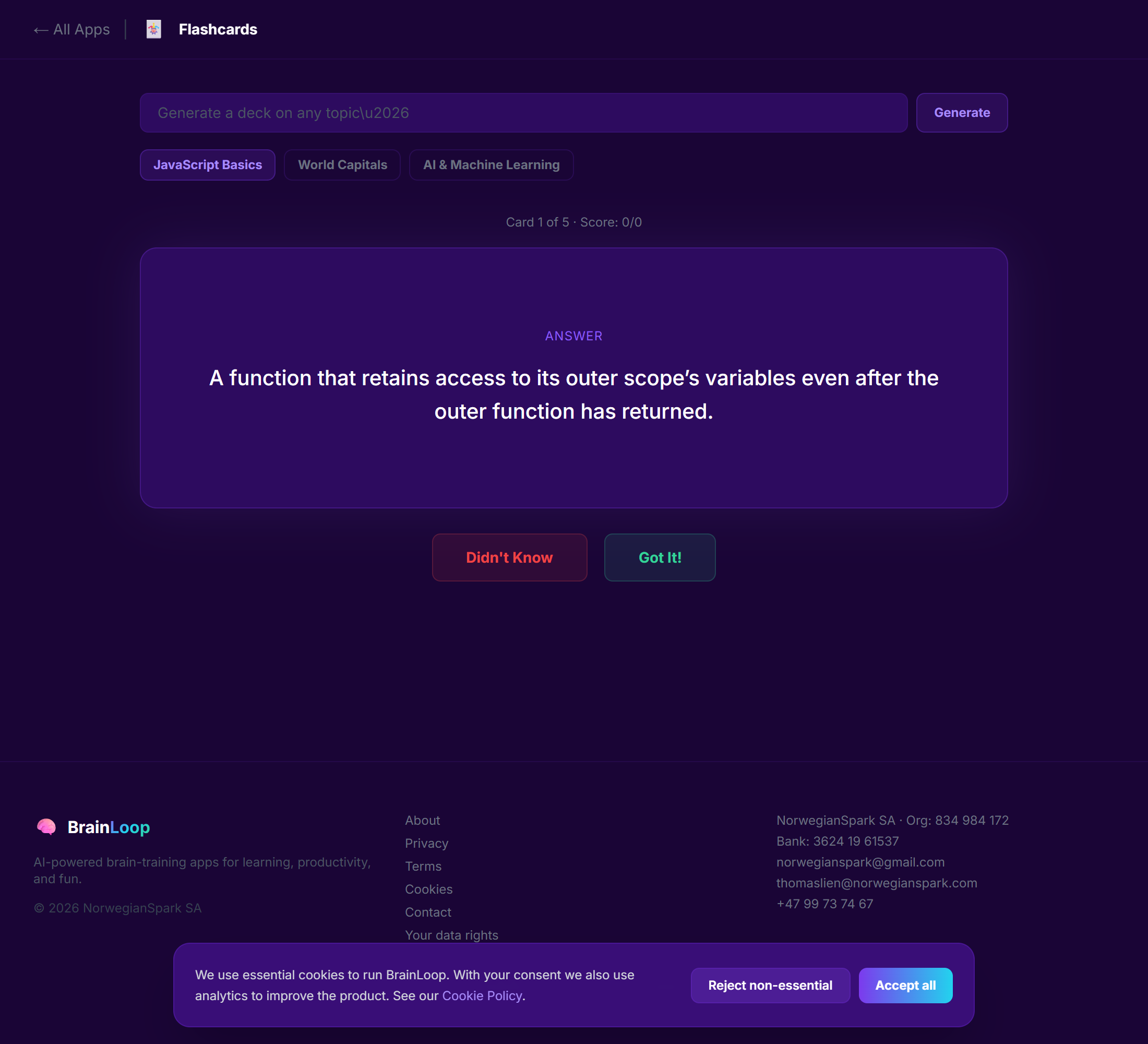
This is exactly the loop BrainLoop's Flashcards app is built around. You pick a deck, read the question, and commit to an answer in your head. Click the card to flip it. Then you press "Got It!" or "Didn't Know" — and that honest self-grade is the whole point. Your running score (e.g. Card 3 of 5 · Score: 2/3) keeps you from quietly fooling yourself. The app ships with ready-made decks — JavaScript basics, world capitals, AI & machine-learning terms — so you can feel the retrieval loop immediately. And you can now type any topic and have it generate a fresh deck with AI in seconds, then drill that deck with the same honest loop (apply the one-idea-per-card and own-words principles above when you review what it makes).
Step 5 — Space your reviews
Don't run a deck once and call it learned. Come back to it tomorrow, then in a few days, then a week later. Each time, the cards you mark "Didn't Know" deserve another pass sooner; the ones you nail can wait longer. That widening gap is the spacing effect doing the heavy lifting — and it's why ten minutes a day beats a two-hour binge the night before.2
Common mistakes that quietly waste your time
- Cards that are secretly mini-essays. If the answer needs a paragraph, it's two or three cards.
- Grading yourself generously. "Close enough" is how you walk into an exam confident and wrong. Be strict on the flip.
- Only ever reviewing in order. You start memorising the sequence, not the facts. Shuffle.
- Making 200 cards and reviewing none. A small deck you actually drill beats a huge one you admire.
The 60-second version
- Break the topic into one-fact questions.
- Write the question in your own words; keep the answer short.
- Answer before you flip — out loud.
- Grade yourself honestly.
- Come back tomorrow, then space it out.
That's the entire method. Build a couple of cards, open the Flashcards drill, and run the loop — the first honest "Didn't Know" you press is worth more than an hour of highlighting.
Sources
Footnotes
-
Pastötter, B., & Bäuml, K.-H. T. (2014). Retrieval practice enhances new learning: the forward effect of testing. (Reviewing the testing-effect literature, incl. Roediger & Karpicke's finding that retrieval practice raises long-term retention above repeated study.) PMC. https://pmc.ncbi.nlm.nih.gov/articles/PMC3983480/ ↩
-
Dunlosky, J. (2013). Strengthening the Student Toolbox: Study Strategies to Boost Learning. American Educator (summarising Dunlosky et al., 2013, Psychological Science in the Public Interest). Practice testing and distributed practice rated "most effective"; rereading and highlighting rated low utility. https://www.aft.org/ae/fall2013/dunlosky ↩ ↩2